Scene I · Bayeux itself
The tapestry, scene by scene
An embroidered account of Harold Godwinson and William, told through Latin captions, a comet and borders crowded with detail.
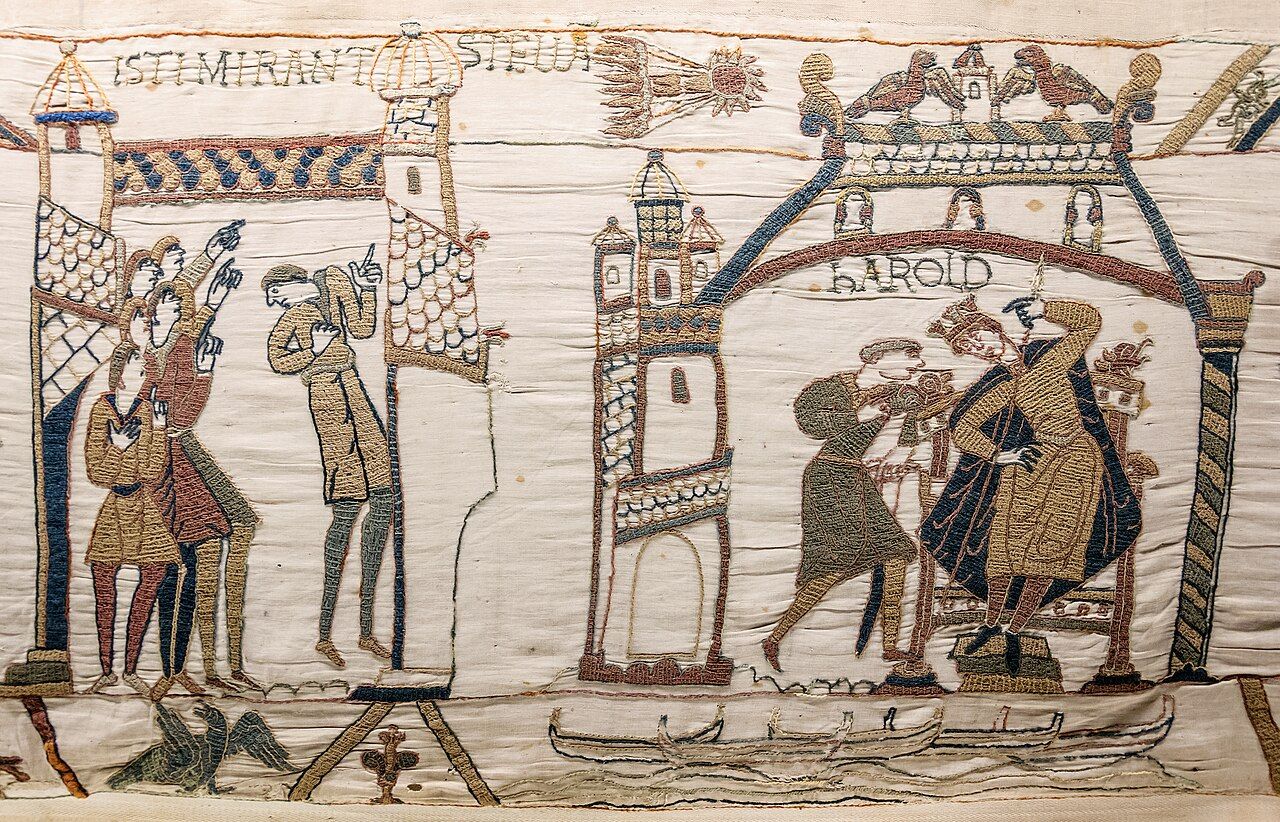

The Bayeux Tapestry is embroidery, not woven tapestry. What does that difference mean? Coloured wool is stitched onto linen. The name misleads; the stitching tells the truth.
The name misleads; the stitching tells the truth.
How large is this embroidered account? It measures about seventy metres long and about fifty centimetres high. That is a long strip, with a fairly narrow field.
What does the strip tell? It follows Harold Godwinson and William, Duke of Normandy. Its story runs up to the Battle of Hastings in 1066.
Why follow these two men? The story centres on Harold and William. Their names, and the battle’s outcome, set the narrative’s boundaries.
Where does the account stop? It reaches the Battle of Hastings in 1066. The object is long, but its stated story has a clear endpoint.
Who made it, and where? It was probably made in England in the 1070s. That answer is deliberately careful: both place and date remain probable.
Why say probably, rather than simply state it? The making is not pinned down absolutely. A firm answer would make the evidence sound firmer than it is.
Who probably ordered the embroidery? Bishop Odo of Bayeux, William’s half-brother. The likely commissioner gives the work a close connection to William’s family.
Does that settle why it was commissioned? Not quite. The probable order tells us who may have wanted it, but not the full reason.
What local connection matters here? Odo’s cathedral in Bayeux was consecrated in 1077. The embroidery and cathedral belong to the same broad period.
Does that prove the embroidery was made for the cathedral? No such destination is established here. The connection is interesting, but it should not be turned into certainty.

For more on that connection, visit the bishop's own cathedral. It is a useful companion, not an answer to every question.
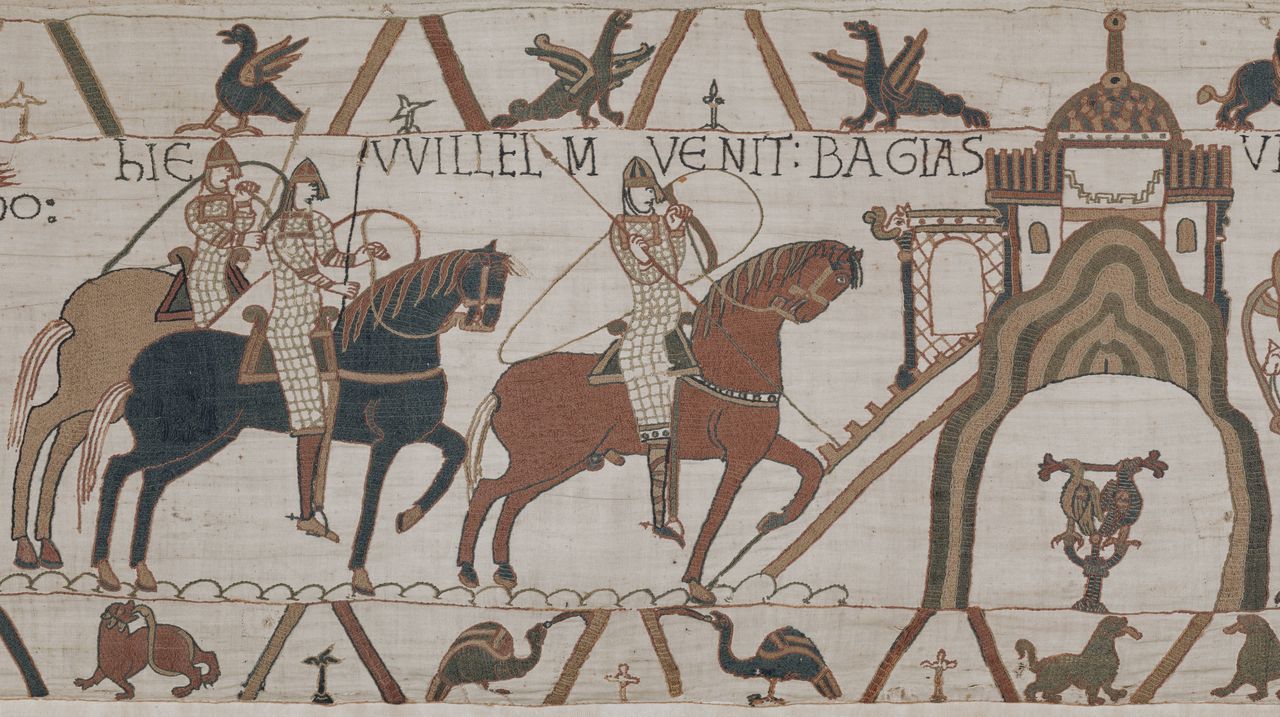
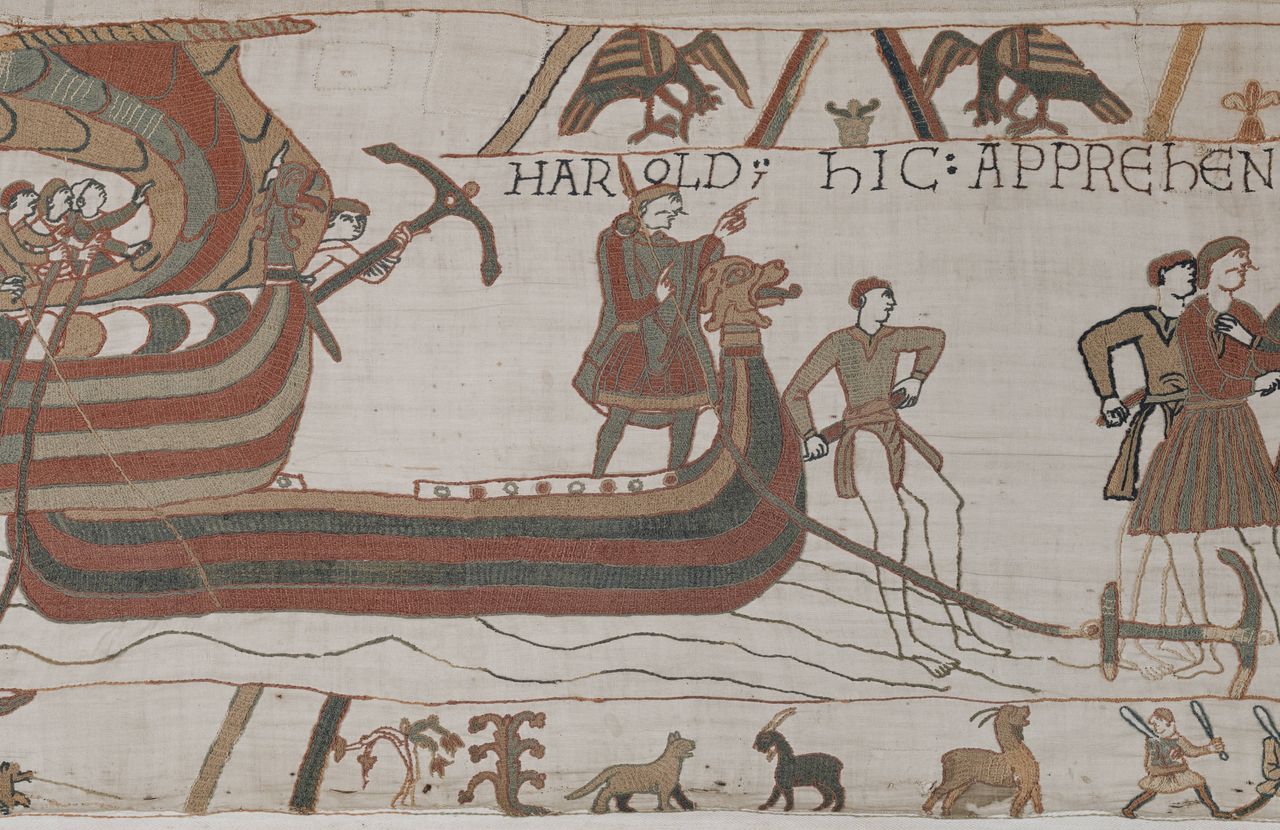
How does the object carry its story? Scenes run along the linen, with Latin captions above. Image and text share the work of telling.
What do the captions add? They place Latin words along the top of the scenes. The pictures are not left to carry the account alone.
Is there a detail that breaks the march towards battle? One scene shows Halley’s Comet, with men pointing up at it. The sky briefly takes the scene.
Why does that moment stay in mind? The men’s gesture gives the comet a place in the story. It is a small scene with a clear visual action.
What fills the borders? Animals and fables appear above and below the scenes. The edges have their own busy company, rather than sitting empty.
Do the borders remain separate from the battle? Near the end, the dead of the battle appear there. The border eventually joins the story’s gravest subject.
Which part deserves the closest attention? The main scenes carry the account, but the borders complicate a quick reading. Skipping them means missing another strand.
Has the embroidery received wider recognition? It was added to UNESCO’s Memory of the World register in 2007. That recognition sits alongside its material and historical interest.
Where could visitors see it for many years? It was shown in a former seminary in town. That building housed the Bayeux Tapestry museum.

Where was that museum? In the centre of Bayeux, within the town. The setting was part of the object’s long public life.
Why is the museum not showing it now? The museum closed in 2025 for rebuilding. The closure explains the change in the embroidery’s location.
Where is the embroidery during the works? It was lent to the British Museum in London. The loan runs from 2026 to 2027.
Is that simply a change of address? It is also a pause in the familiar arrangement. The museum is being rebuilt while the embroidery is elsewhere.
What should the story be paired with next? William’s later memory has another point of entry in the Conqueror's tomb. The embroidery itself remains focused on Harold and William.
Pull the next thread: Bayeux by the Aure: old lanes, wheels and timber
And what sits beyond this one object? The town offers another way to keep the story in place.
What is easiest to overlook? The object’s name, its narrow height, and its borders. Each can mislead if the scenes alone get all the attention.
What remains unresolved after following the scenes? The likely maker and commissioner are not absolute answers. How much more can a stitched account tell?
- On display for many years in a former seminary in the centre of Bayeux.
- The museum closed in 2025 for rebuilding.
- Lent to the British Museum in London from 2026 to 2027.
- How far from the cathedral in town
- Where exactly centre of Bayeux
Notre-Dame de Bayeux, from crypt to lantern • Bayeux by the Aure: old lanes, wheels and timber