Scene XIV · Seaward
Colleville and Omaha Beach: bluff, path, shore
A morning-to-afternoon route links the cemetery above Omaha Beach with the path down and Les Braves on the sand at Saint-Laurent.
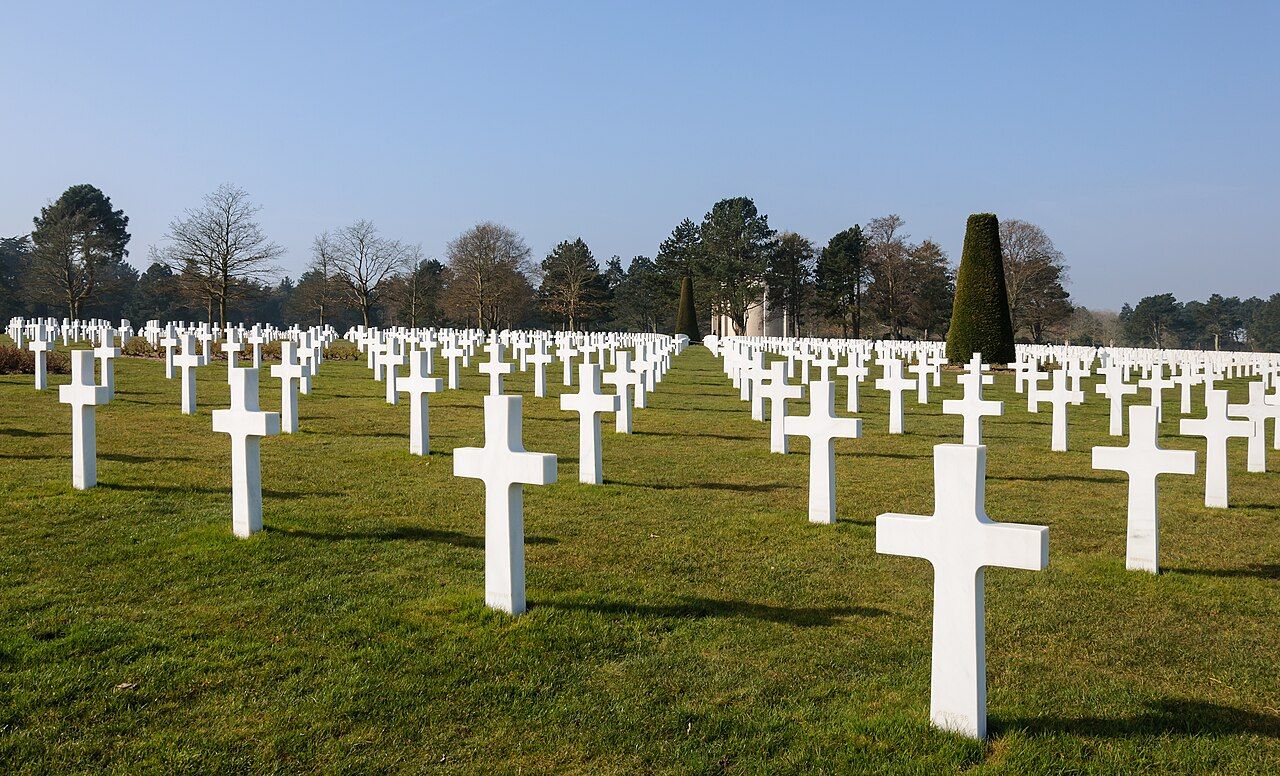

What is the scene from the bluff? The Normandy American Cemetery stands above Omaha Beach at Colleville-sur-Mer. The beach is not an afterthought below it. A path leads down from the cemetery to the shore. The change in level gives the visit its simple shape: memorial, descent, beach. The bluff has planned the itinerary, which is efficient of it.
What belongs in the morning? Begin with the cemetery itself, rather than treating it as scenery above the beach. It holds 9,388 graves. That number is plain, and difficult to hold in mind. The American Battle Monuments Commission runs the cemetery. The ground and its care are part of the story, not merely a preface to the view below.
What should take the eye after the graves? The Walls of the Missing carry 1,557 names. The count changes the scale of attention. Graves occupy the cemetery; names on the walls mark another form of remembrance. This is where I would resist a brisk circuit. There is no clever shortcut through a place whose details ask for separate attention.
What stands within the memorial? A bronze statue is called The Spirit of American Youth Rising from the Waves. Its name brings the sea into the cemetery before the path reaches the beach. The phrasing is emphatic; the bronze gives that idea a physical form. The route keeps returning to the same elements: names, memorial, water, and the ground between them.
What suits midday? Take the path down, if the beach belongs in the visit. It leads from the cemetery to Omaha Beach, joining the bluff and shore without requiring a second story to explain them. The descent is the useful hinge. I favour it over imagining the cemetery and beach as separate stops. The land has already connected them.
What changes at the bottom? The cemetery is above; the beach is below. That is the essential geography, without dressing it up. The path makes the difference tangible, and the shore completes the movement. For another coastal point of reference, there is the scallop harbour. The coastline offers more than one way to think about its edges.
Pull the next thread: Arromanches and the Harbour Towed Across
What should late afternoon include? At Saint-Laurent, on the beach, stands Les Braves. It is a steel sculpture by Anilore Banon, set up in 2004. The sculpture puts a distinct object on the sand, rather than another marker on the bluff. I would keep it in the route; skipping the shore would leave this part of the story out.
How do the two memorials speak differently? The cemetery holds graves, names and a bronze statue. The beach holds Les Braves, a steel sculpture. The materials and positions differ; the route links them. This is not a competition between memorials, though the itinerary has a satisfying mechanism: climb, consider, descend, then look again from below.
What remains open at the end? The path can be walked in one direction, but the questions do not settle so neatly. How does a place hold names, graves and sculpture together? The bluff gives one answer, the beach another. The walk between them leaves the question alive.
- Where: Colleville-sur-Mer.
- From Bayeux: about 17 km north-west.
- The cemetery holds 9,388 graves.
- The Walls of the Missing carry 1,557 names.
- Les Braves stands on the beach at Saint-Laurent.
- How far from the cathedral about 17 km north-west
- Where exactly Colleville-sur-Mer
Cider, pommeau and calvados: the orchard in a glass • Isigny: Butter, Cream and a Protected Name