Scene VI · Bayeux itself
Bayeux on foot, from market morning to river evening
The Saturday market opens a day on foot through Bayeux, followed by the cathedral, boulevard memorial and Aure.

Bayeux has about thirteen thousand people. What makes a day here legible? A sequence of places, not a race between pins. I like a route with a clear order. Does every stop need a clock? No; the town supplies its own markers.
On Saturday, where does the morning begin? The market fills Place Saint-Patrice. A market is useful in a route because it has a place and a stated part of the day. Here both are plain: Place Saint-Patrice, morning. I would keep this opening simple, rather than invent errands around it.
What comes after the market? The cathedral gives the day a different kind of focus. It is open to visitors most days, so it can sit naturally in this sequence. The useful detail is not a grand claim about the building. It is the way its position keeps turning up in the town's view.
How does the cathedral make itself known? Its towers are visible from most of Bayeux. The west front faces a small square, which gives the building a specific face and setting. I like these practical facts better than vague directions. Look for the towers, then find the square facing the west front.
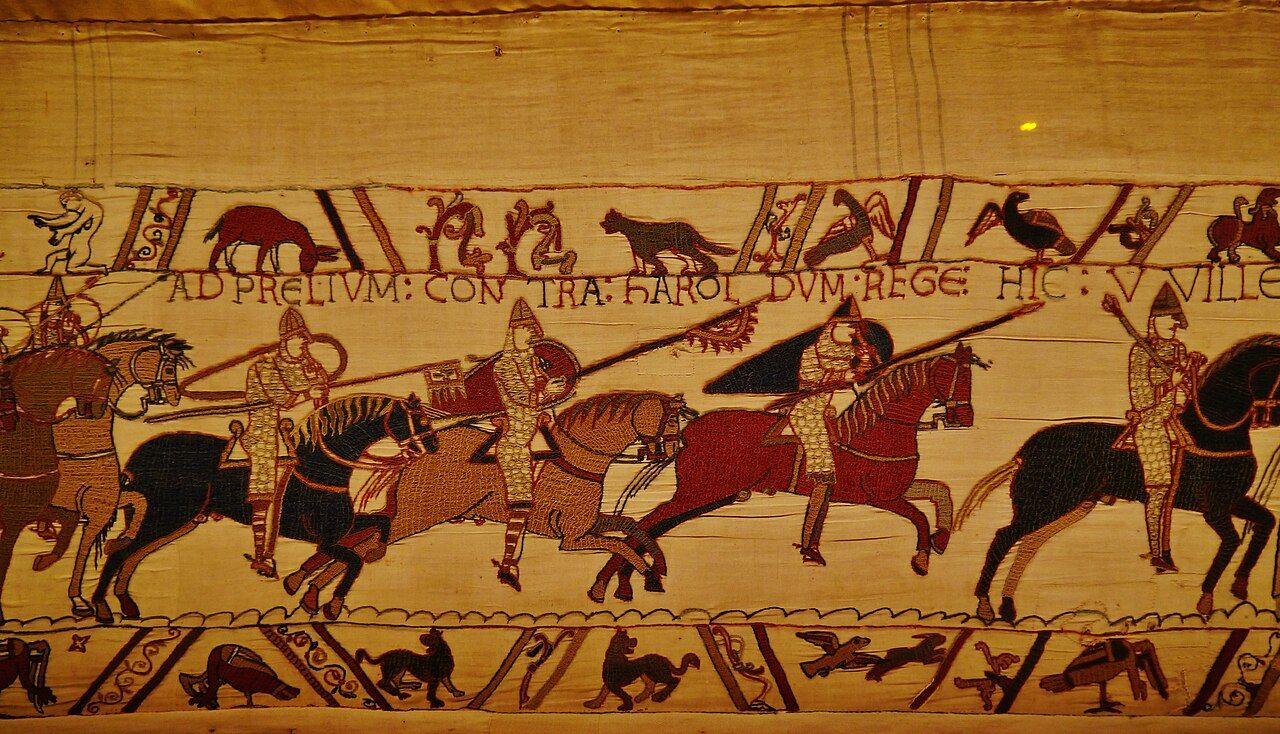
And where does the long embroidered strip enter this sequence? It offers a different kind of close looking alongside the town's visible landmarks. This walk stays arranged by places and their positions. It can be a pause in that pattern, rather than another reason to turn the day into a checklist.
What changes the subject after the cathedral? The war cemetery and memorial lie on the boulevard south-west of the centre. The direction matters: this is not another square-front landmark. It gives the day's route a distinct bearing, and asks for a different sort of attention. I would not hurry this part simply to keep an itinerary tidy.
Pull the next thread: June 1944 in Bayeux: a town barely damaged
What carries the walk onward? A town route can be read by its edges as well as its landmarks. The boulevard places the cemetery and memorial south-west of the centre; the river path gives the final stretch its own line. That change of shape is a welcome piece of town mechanics.
Can the day finish beside the river? The path along the Aure leads between the old mills. It is a clear, physical description: a river, a path, mills on either side of its course. After the square and boulevard, I like the route's shift from facing buildings to following water.
What belongs to evening? The Aure path is the day's river ending. In summer, the cathedral is lit after dark, a separate note in the evening sequence. The day can hold both details without pretending they are the same view. One follows the river; the other changes the cathedral after daylight.
So what is the day's order? Market, cathedral, boulevard, then the Aure. Bayeux's towers help orient the middle of it, while the named places keep the rest grounded. The route has landmarks, but no need for a stopwatch. Which part would deserve the longest pause?
- How far from the cathedral in town
- Where exactly all over town
Balleroy: the château at the end of the street • Beeches and Beetles in the Forest of Cerisy